
Why one number is never the full story
IVF success is often presented as a single percentage.
But for patients, success is never one number. It is a journey with an outcome.
At Avenues, we define success as:
- A healthy baby
- In the shortest realistic time
- With the fewest cycles and lowest overall cost
- And with the best possible experience along the way
That is why we measure success per patient, not just per cycle or per procedure.
Most patients do not have a baby from a single IVF cycle. Planning and optimising across the entire journey improves outcomes, reduces unnecessary cost, and avoids repeated emotional resets.
To understand why this matters, it helps to look at how IVF success rates are currently reported in the UK.
Why traditional IVF success rates can be misleading
The HFEA is the UK fertility regulator, and clinics like ours are required to report our outcomes to them. This regulatory oversight is important.
However, the way success is defined and reported has changed multiple times over the years:
- Before 2010: live birth per embryo transfer procedure
- 2010–2025: live birth per cycle started and per embryo transferred
- From 2025:
- live birth per egg collection (including PGT-A)
- live birth per embryo transferred (excluding PGT-A)
- For IVF add-ons: success per cycle started
As a patient, this can feel confusing and overwhelming. But the implications are real.
Today’s published HFEA success rates are per procedure, not per patient.
They do not reflect how many cycles you may need, how long your journey may take, or what it may cost emotionally or financially.
They also unintentionally incentivise clinics to focus on improving headline numbers rather than designing care around what helps patients most.
At Avenues, if we must choose, we choose the patient: not the ranking.
We actively advocate for success reporting that genuinely helps patients make informed decisions. Unfortunately, that is not how success is currently presented.
What IVF success numbers don’t show
Current metrics cannot tell you:
- Which clinics maximise your cumulative chance of a baby, and which may unintentionally compromise it
- Your realistic chance of success as an individual, especially in more complex cases
- How many cycles you are likely to need, or the time, cost, and emotional load involved
- Whether viable embryos may be discarded to improve reported success per embryo transferred
For example, some clinics adopt policies where only fully expanded blastocysts are transferred because they perform better per embryo transferred. However, non-expanded blastocysts can and do result in healthy babies. Excluding them may improve a statistic while reducing a patient’s overall chance of success.
From a patient’s perspective, success is cumulative.
It is the baby at the end of the journey, not the performance of a single cycle.
Why PGT-A makes comparisons even harder
Another source of confusion is PGT-A testing.
Some HFEA success metrics: include cycles with PGT-A
Others: exclude them
Some: mix both without clear explanation
PGT-A can increase success per embryo transfer for certain patients, but it is:
- expensive
- not appropriate for everyone
This inconsistency can allow success rates to be unintentionally “gamed”. For example, offering PGT-A to lower-chance patients can exclude those cycles from certain metrics, regardless of whether PGT-A is clinically the right choice.
The result is that two clinics may quote similar HFEA success rates while delivering very different journeys in time, cost, stress, and number of procedures.
How we measure success at Avenues
We respect cycle-level data and report fully to the HFEA.
But we design treatment around what actually matters to patients:
- Live birth per patient
- Time to baby
- Cost to baby
- Fewer failed cycles and fewer unnecessary procedures
Patients do not want a “successful cycle”.
They want a baby, achieved in the shortest number of procedures possible for their personal reality.
That difference in focus shapes everything from clinical planning to how we structure our treatment packages.
Fair IVF: success within a clearly defined journey
This philosophy is why every treatment pathway at Avenues is carefully engineered to the individual.
For example, Fair IVF is designed for a very specific patient demographic with clearly defined eligibility criteria. Success is measured per patient within that cohort, not across unrelated populations.
We are transparent about who Fair IVF is for, who it is not for, and what outcomes patients can realistically expect. Even if this approach does not always produce the most impressive headline rankings, your chance of having a baby is never compromised for optics.
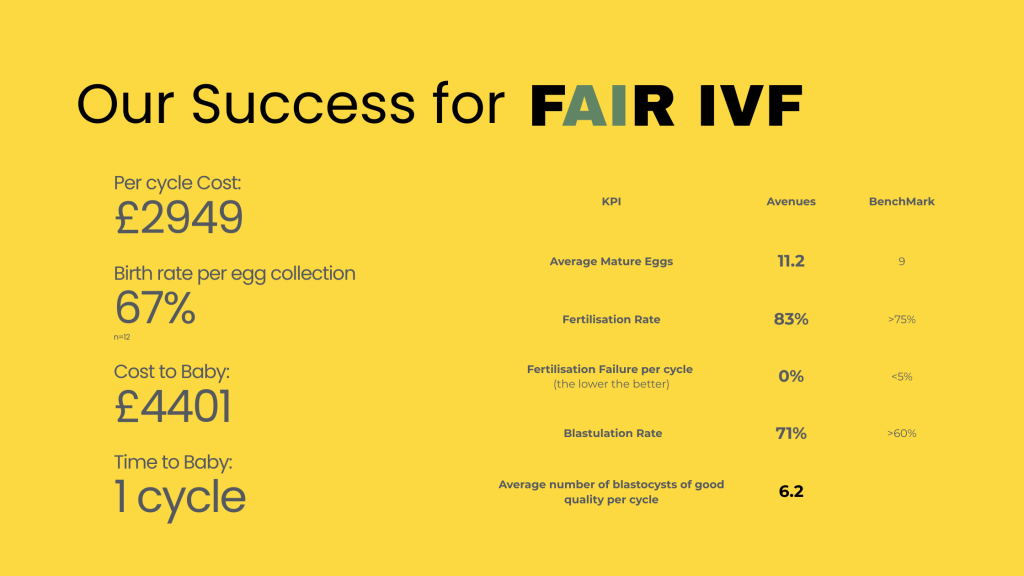
Fair IVF success is measured per patient, not per cycle. We show success via one clear treatment pathway, transparent inclusion and exclusion. One population. One journey.
Learn more from our Founder
If you would like a deeper clinical explanation of IVF success metrics, cumulative outcomes, and how reporting systems affect patient care, you can watch our Founder discuss this in detail at Fertility 2026.
Final thought
IVF success should not be about winning tables.
It should be about building families.
At Avenues, we do not optimise cycles.
We optimise for family.