
Being told there’s no sperm in a semen sample is one of the hardest moments in a fertility journey. It’s called azoospermia, and it affects around 1 in 100 men. For many, it isn’t the end of the road: sperm can often still be found inside the testicles and retrieved in a small operation, then used for ICSI.
The hard part comes next. In the lab, an embryologist searches the retrieved tissue under the microscope, cell by cell, looking for a few sperm among thousands of other cells. It can take hours, it depends heavily on experience, and the clock is running: the sooner sperm are found, the better they’re preserved.
What we tested
Our embryology team compared three ways of searching the same tissue from men with non-obstructive azoospermia (where the testicles make very little sperm):
- an embryologist searching on their own (senior and junior)
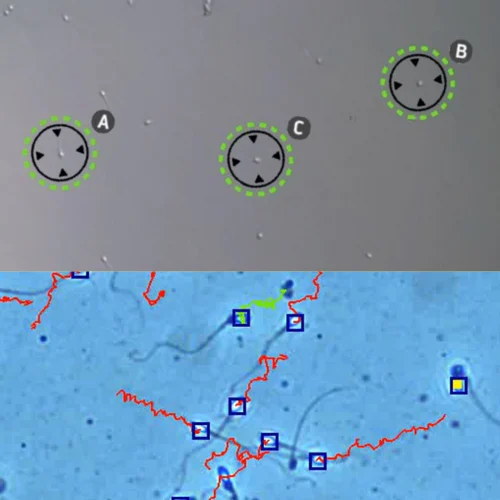
- the same embryologists working with AI software that highlights likely sperm on screen
- the AI working on its own
Each sample was split into equal parts, so every method searched comparable tissue. These were the first reported cases of this approach in the UK.
What we found
- Faster to the first sperm. With AI support, a senior embryologist found the first sperm in about 5 seconds per strip instead of 16. A junior embryologist went from 24 seconds to 9.
- Faster to a confident “no”. Where no sperm were present, the AI-assisted search finished in 28 minutes instead of 65. Knowing quickly, and with more confidence, matters as much as finding sperm.
- The biggest gain for less experienced staff. AI narrowed the gap between junior and senior embryologists.
These are early results from a small number of patients, and larger studies are needed. But they point to a practical change: more of the tissue can be searched properly in the time available.
What this means for you
- A diagnosis of azoospermia doesn’t automatically mean donor sperm. Surgical sperm retrieval, such as micro-TESE, may be an option, and how thoroughly the lab searches the tissue can make the difference.
- Faster searching helps keep the sperm that are found in good condition for ICSI.
- If no sperm are found, a faster and more confident answer helps you plan next steps sooner, including donor sperm if you choose it.
Want to hear more?
Join our free online event, Man + Machine: AI & Your Fertility, on Tuesday 10 November at 6pm, with Professor Amr Raheem (male infertility), Dr Halil Ruso (laboratory innovation) and Dr Valentina Mauro. Save your place.
If you’d like to talk about your own results, book a free 15-minute call with our team.
Based on our research abstracts “Accelerating sperm identification in non-obstructive azoospermia” and “AI-driven sperm detection in micro-TESE” (Avenues embryology team).